 Easy BACnet
What are BACnet Who-Is and I-Am?
Updated 4 November 2026
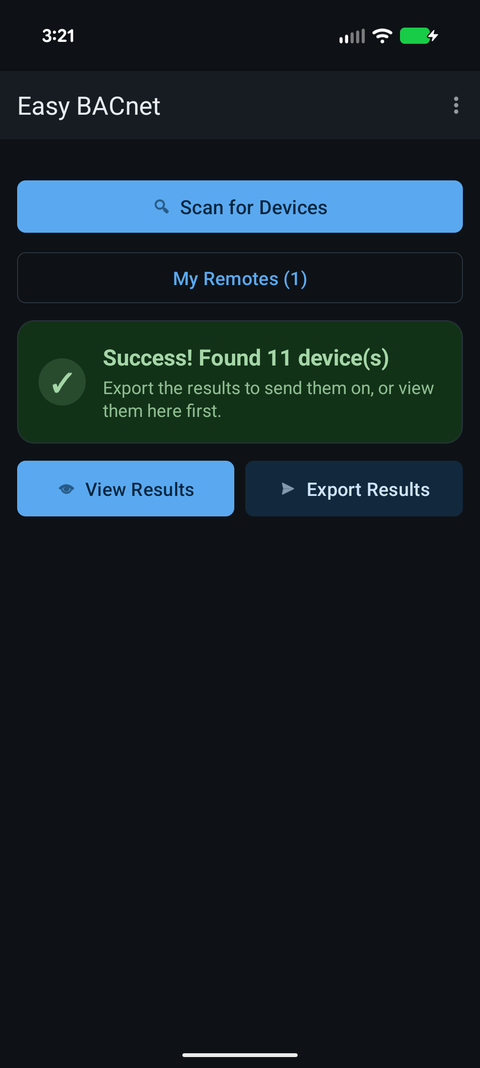
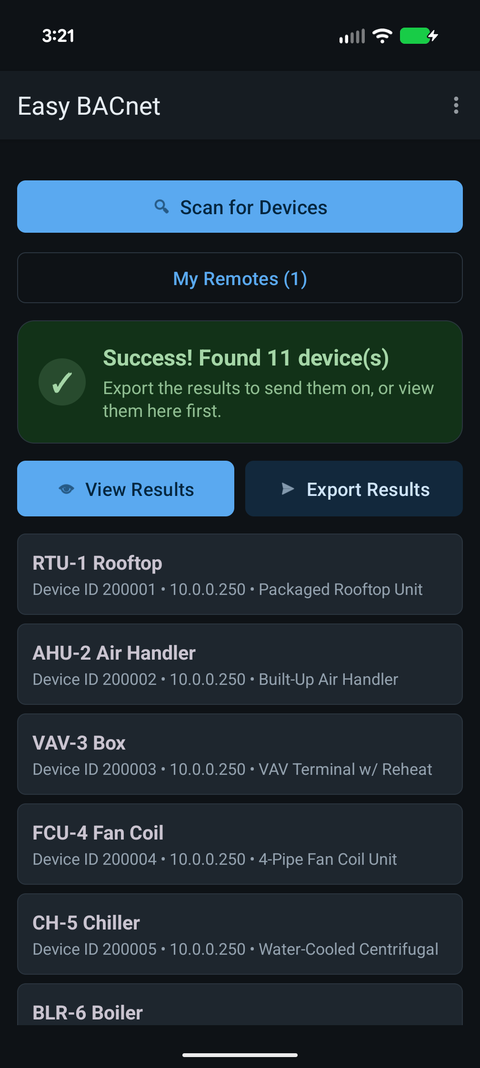
Who-Is and I-Am are the two messages behind BACnet discovery. A tool broadcasts a Who-Is, and each device that hears it (and falls inside the instance range asked for, if there is one) answers with an I-Am carrying its Device Instance, its vendor ID, its maximum message size and whether it supports segmentation. Collect the replies and you have a device list. That is what Easy BACnet does when you tap Scan for Devices.
The exchange
On BACnet IP a Who-Is goes to the subnet's broadcast address on UDP 47808, so every device on that subnet gets it at once. A Who-Is can be unconstrained (everyone answer) or carry a low and high instance limit, which is how a head-end asks for device 20114 alone without hearing from the whole building. Many devices broadcast their I-Am back rather than replying only to the sender, which is why a busy site's I-Ams are seen by every tool on the subnet.
What an I-Am carries
- Device Instance — the device's number, which has to be unique across the whole BACnet internetwork, not just the subnet. Two devices sharing one makes discovery and reads unreliable: see BACnet Device IDs explained.
- Max APDU length accepted and segmentation supported — the largest message the device takes (50 to 1476 bytes; small MS/TP controllers are often 480 or less) and whether it can split a long reply into segments. A tool uses these to decide how to read; Easy BACnet reads one property at a time, so it works with devices that support neither.
- Vendor ID — the ASHRAE-assigned number for the manufacturer. Look any number up with our BACnet Vendor ID lookup.
The source address of the I-Am matters too. A device behind a BACnet router answers through the router, so its reply comes from the router's IP with a network number and MAC address inside the BACnet header.
Why a scan sometimes finds nothing
Who-Is is a broadcast, and IP routers do not forward broadcasts, so a device on a different subnet never hears it unless a BBMD carries it across. That is the usual reason a scan comes back empty: see why can't I find my BACnet IP devices?. Devices on an MS/TP trunk answer too, because the BACnet router passes the Who-Is down the trunk and the I-Ams back up. Some devices also answer badly or late, so Easy BACnet repeats the Who-Is through the scan and, if nothing answers, probes the subnet's addresses directly.
Check it on your own network. Easy BACnet is a free Android app that finds BACnet IP devices and reads their points in a couple of taps.
Get it on Google Play