 Easy BACnet
What is BACnet?
Updated 11 October 2026
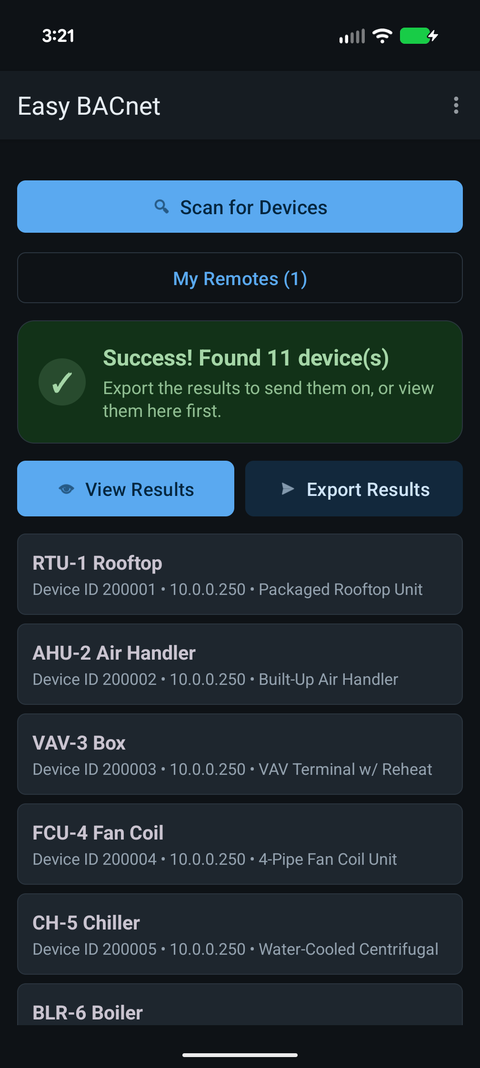
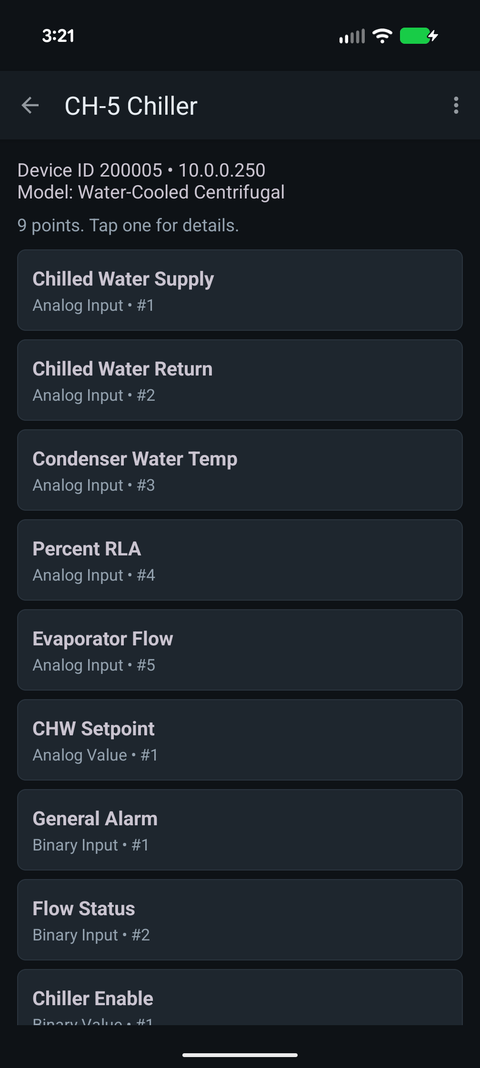
BACnet is the open protocol most building controls use to talk to each other and to the BAS front end. It's defined by ASHRAE Standard 135 (also ISO 16484-5), so a VAV controller from one manufacturer can be read by a head-end from another. On most sites it runs as BACnet IP (UDP port 47808) on a controls network or VLAN kept apart from the office network, with smaller field controllers on MS/TP serial trunks behind routers. Each controller is a device; each value inside it, such as a temperature, a fan command or a setpoint, is an object, usually called a point. Easy BACnet shows all of that on a phone connected to the BACnet IP network.
Why it exists
Before BACnet, each controls manufacturer had its own proprietary protocol, and mixing brands meant gateways or a rip-and-replace. ASHRAE published BACnet in 1995 as a vendor-neutral standard for how controllers describe themselves and exchange values. Today a Trane RTU controller, a JCI VAV controller and a Schneider power meter can sit on the same network and be read by the same tool.
Devices, objects and properties
- Device: one controller, gateway or smart piece of equipment. It has a Device ID (instance number) that must be unique on the whole BACnet network, and on BACnet IP an IP address.
- Object: one thing inside the device, such as an Analog Input for a space temp, a Binary Output for a fan start/stop, or an Analog Value for a setpoint. Each has an object type and an instance number.
- Property: a field on an object.
Present_Valueis the one you usually want; others includeObject_Name,Units,Status_FlagsandDescription.
Every device keeps an Object_List property naming all its objects. Read out
with names and values, that's its points
list.
Finding devices
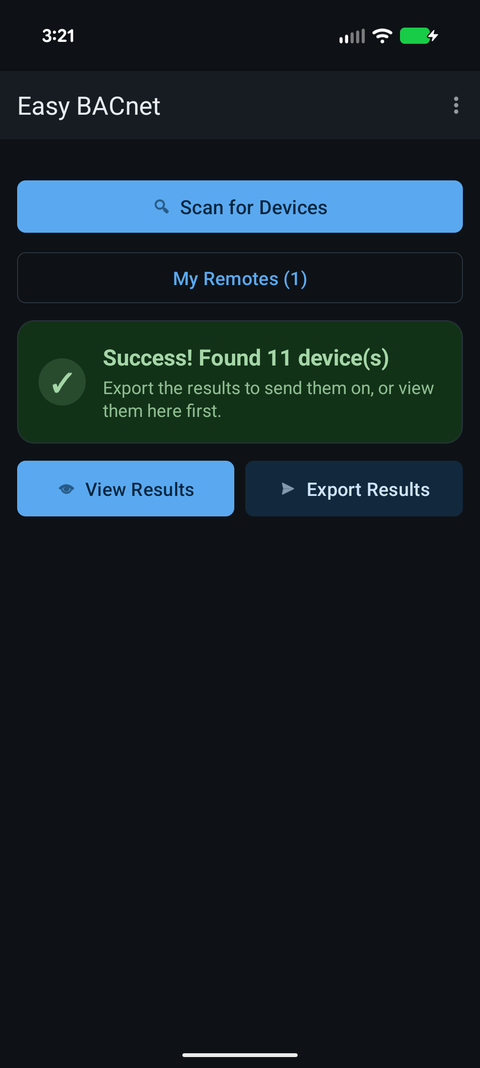
A tool doesn't need to know addresses up front. It asks the whole network “who's out there?” and every BACnet device answers with its Device ID. That's what happens when you tap Scan for Devices in Easy BACnet. The question only reaches your own subnet (unless the site has a BBMD to pass it on), so a device on another subnet won't show up in a plain scan. The technical names for the question and answer are Who-Is and I-Am.
BACnet IP and MS/TP
- BACnet IP runs over Ethernet on UDP 47808. Supervisory controllers, plant controllers and many newer field controllers use it. This is what a phone or laptop reaches, usually by plugging into a controls switch or joining the BAS VLAN.
- BACnet MS/TP runs on an RS-485 twisted pair and is common for VAVs, fan coils and unit controllers. A phone can't reach MS/TP directly, but devices behind a BACnet router are reachable over IP.
Where Easy BACnet fits. It's a BACnet IP browser. Get the phone onto the controls network, scan, and it lists the devices, their points, live values, and which priority is commanding each point. With write mode on it can also command and release points. It doesn't connect to an MS/TP trunk directly.
What it's used for
Mostly HVAC: AHUs, RTUs, VAVs, chillers, boilers, pumps, fan coils. Also lighting panels, power and utility meters, and some integrations with access control and fire systems. If a building has a BAS or BMS, BACnet is very often what's underneath it.
See it for yourself
The quickest way to understand it is to look at a live system: run a scan, open a device and browse its points. Keep the BACnet glossary handy for the terms.
Check it on your own network. Easy BACnet is a free Android app that finds BACnet IP devices and reads their points in a couple of taps.
Get it on Google Play