 Easy BACnet
What is a BBMD, and when do I need one?
Updated 16 September 2026
A BBMD — BACnet Broadcast Management Device — forwards BACnet/IP broadcasts from one IP subnet to another. BACnet discovery leans on broadcasts, and IP routers deliberately do not pass broadcasts, so equipment on a different subnet is invisible until a BBMD carries the broadcast across. You need one whenever BACnet/IP has to span more than a single subnet.
Why broadcasts are the problem
A Who-Is is a broadcast: it reaches every device on the local subnet in one shot. That is efficient, but a router's whole job is to not forward broadcasts, or they would flood the network. So the moment your equipment sits on a different subnet from the tool looking for it, discovery stops at the router.
What a BBMD does
One BBMD sits on each subnet that has BACnet/IP devices. The BBMDs know about each other through a Broadcast Distribution Table. When a broadcast arrives on one subnet, its BBMD wraps it up and unicasts it to the other BBMDs, which re-broadcast it locally. The result is that a Who-Is sent on subnet A is heard by devices on subnet B, without opening the routers to general broadcast traffic.
Foreign Device Registration
A tool that is not on any BACnet subnet — a laptop or phone on office Wi-Fi, say — can ask a BBMD to include it as a foreign device. The BBMD then forwards broadcasts to it directly for a time. It is the standard way a piece of software reaches equipment it is not physically alongside.
What this means for a phone scan
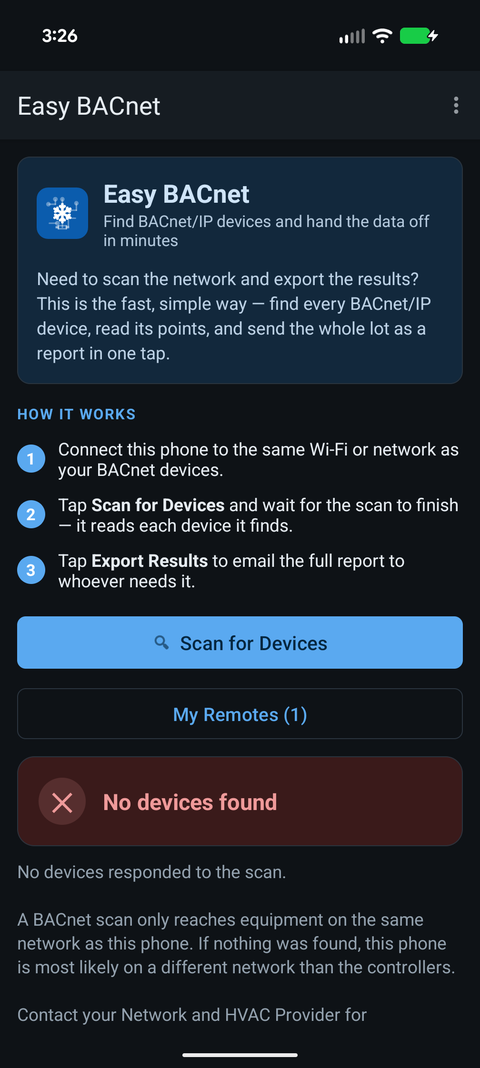
Easy BACnet scans the subnet the phone is on. If the equipment is elsewhere and there is no BBMD reaching your phone, the scan finds nothing — not because the app failed, but because the broadcast never crossed the router. The reliable fix on site is to get the phone onto the same subnet as the controllers; see why can't I find my BACnet devices?.