 Easy BACnet
BACnet MS/TP vs BACnet/IP — what is the difference?
Updated 16 September 2026
BACnet/IP carries BACnet over ordinary Ethernet and Wi-Fi networks using UDP 47808. BACnet MS/TP (Master-Slave/Token-Passing) carries it over a cheap RS-485 serial twisted pair. IP is fast and everywhere; MS/TP is slow and inexpensive, which is why most individual field controllers are MS/TP and reach the wider network through a BACnet router.
Different wires, same BACnet
The objects, the points and the services are identical; only the bottom layer differs. BACnet/IP rides on the building's data network. MS/TP rides on a two- or three-wire RS-485 bus daisy-chained from controller to controller, typically at 9600 to 115200 baud — a fraction of Ethernet speed, but enough for a VAV box reporting a temperature.
Token passing
MS/TP devices share one wire, so they take turns: a token is passed from master to master, and only the holder may speak. It is robust and cheap, but it puts a ceiling on how fast a trunk can be polled — part of why reading a large MS/TP unit is not instant.
Addressing and how they meet
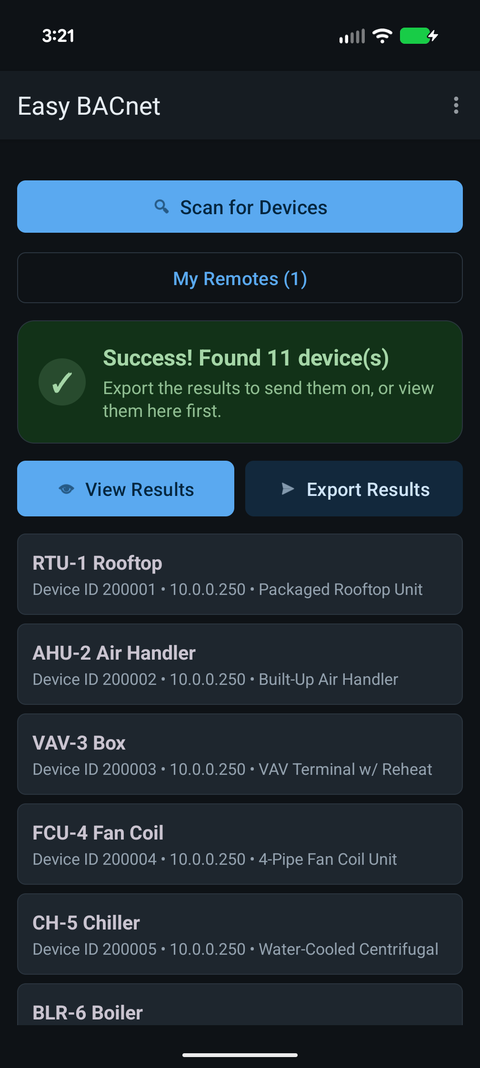
On MS/TP a device has a small MAC address (0–127) on its trunk, plus a network number for that trunk. A BACnet router joins the MS/TP trunk to BACnet/IP, so from the IP side each MS/TP device appears as a normal BACnet device with its Device Instance. That routing is why Easy BACnet, which speaks BACnet/IP over Wi-Fi, can still list and read MS/TP controllers — provided a router is carrying them onto the subnet your phone is on.
Which am I looking at?
If a device shows a network number greater than the local one and a low MAC address, it is almost certainly an MS/TP device reached through a router. Pure BACnet/IP devices sit on the IP network directly with their own IP address.